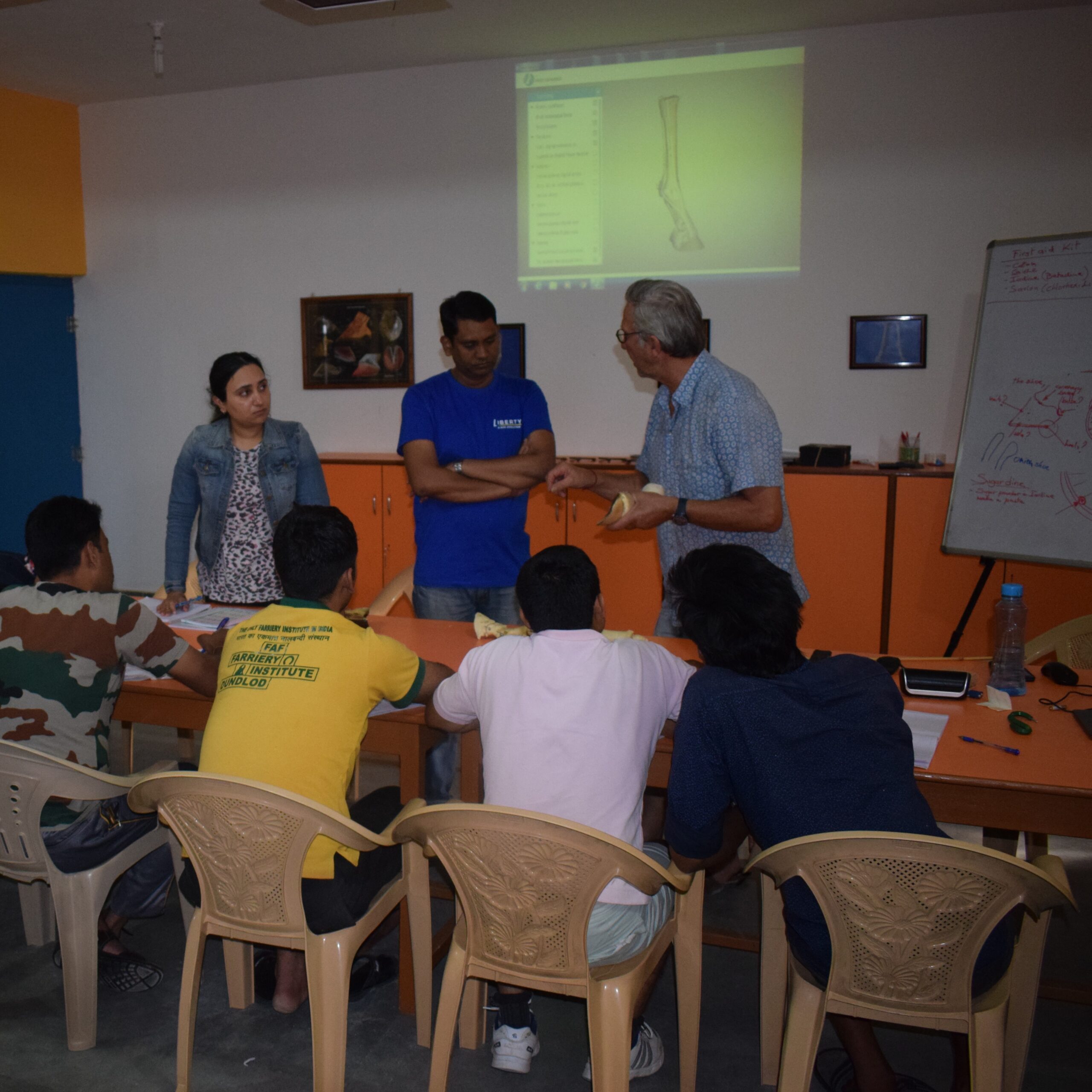
The FAF-Farriery Institute Dundlod provides modular courses and workshops that are taught by a worldwide network of highly qualified farrier volunteers prepared to give their time and share their knowledge. They are supported by local Indian teachers.
The modular courses run full-time at the Foundation’s institute in Dunlod, Rajasthan. The course covers topics like Anatomy, horse handling, trimming, cold shoeing, forging and hot fitting, lameness, corrective shoeing and more.
Upon completion of the 2 modules and the final exam, students are awarded a Farriery course completion certificate. After 2 years practical work experience, candidates undergo graduation exam (theory and practical) that attests their ability to provide high quality farriery and grants them professional recognition.
Courses Offered
Continuing Education Course for Veterinarians
These courses are specially designed for practicing veterinarians seeking to specialize in equine medicine. They are taught by highly qualified international equine specialist veterinarians in the fields of orthopedics and lameness. Additionally, skilled farriers will provide instruction in corrective shoeing for horses with hoof or locomotor pathologies.
The duration of these courses is 4 days.
Course contents:
- Review of the anatomy of the front and hind limbs of the horse
- The main bone, joint, ligament, and tendon pathologies of the horse’s limbs
- Recommended treatments for the above-described pathologies
- Diseases, accidents, injuries of the horse’s hoof
- Clinical examination of lameness
- Various joint tests
- Pharmacopeia
- Modern farriery, trimming, hoof care
- Simple shoeing, its principles
- Shoeing adapted to different pathologies
- The importance of collaboration between veterinarians and farriers
- The veterinarian, the farrier as educators for horse owners
Our Faculty
We have visiting faculty from all over the world. All our faculty are trained farriers themselves.

Bernard Duvernay
Master Farrier

Sandeep Shelar
Farrier Trainer, School Manager

Gaje Singh
Farrier Trainer

Kan Singh
Farrier Trainer
Our Facilities
1 Acre farm
Our institute is spread across 1 acre farm
300 horses
Our institute has access to over 300 horses
Classrooms
We have well maintained classrooms with projectors
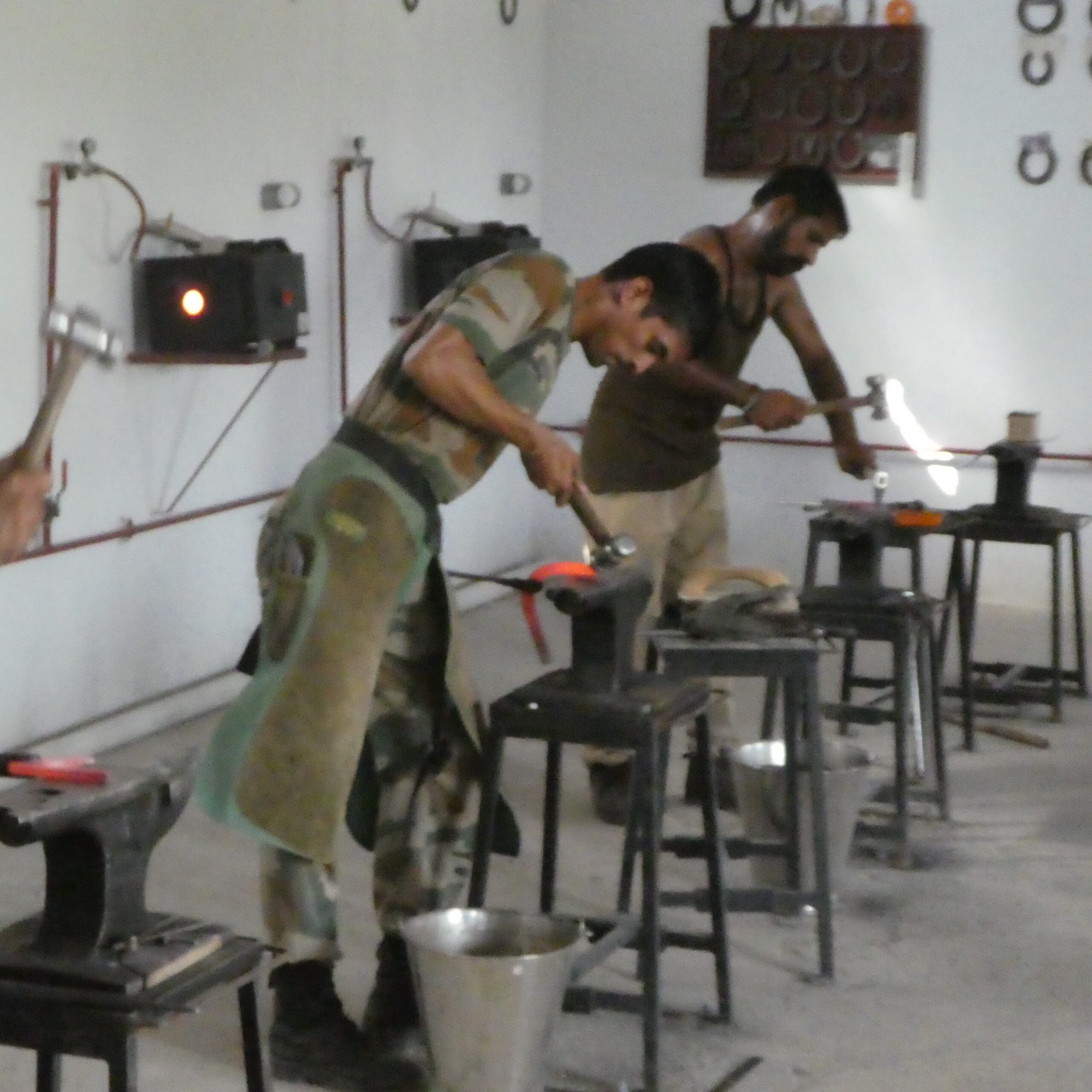
Forging Workshop
Our forging workshop has the best in class equipment
Dormitory
Our well maintained dormitory has space for hostel students
Kitchen and Pantry
Our kitchen and pantry provides nutritious food for our students
Farriery Course
The school offers courses at different levels:
N° 1
courses for beginners, for individuals who have never worked in the profession but have experience with horses. The course includes an introduction to anatomy, knowledge of limb conformations, learning horse handling and observation. Understanding normal conformation and various abnormalities that can affect hooves. The hoof, its physiological movements, diseases, and care, hoof injuries and treatments.
Trimming, tools, work safety, hoof balance and landmarks. Effects of trimming on joints, ligaments, and tendons. Limb gaits.
Shoeing, tools, hoof preparation for shoeing, shoes, nails, safety, shoe selection, shoe adjustment, finishing, nailing, nail rivets, shoe and hoof finishing.
These courses have a duration of 36 days divided into 2 modules of 3 weeks.
N° 2
courses for individuals already in the profession or with a good understanding and experience working on hooves.
The course includes an in-depth introduction to anatomy compared to the beginner course, analysis of limb conformations, observation of the horse’s limbs and stance. Understanding normal conformation and abnormalities that affect hooves, shoe wear.
The hoof, its physiological movements, diseases, and care, hoof injuries and treatments.
Trimming, tools, work safety, hoof balance and landmarks. Effects of trimming on joints, ligaments, and tendons. Limb gaits.
Shoeing, tools, hoof preparation for shoeing, shoes, nails, safety, shoe selection, shoe adjustment, both cold and hot fitting, finishing.
Nailing, nail rivets, shoe and hoof finishing.
Cold and hot shoeing. Shoeing based on horse activities, work, sports disciplines, etc.
Corrective shoeing, shoes used to treat major diseases or pathologies.
These courses have a duration of 36 days divided into 2 modules of 3 weeks.
Equine veterinarian courses
N°3
Continuing education courses for veterinarians.
These courses are specially designed for practicing veterinarians who wish to specialize in horses. They are taught by highly qualified equine veterinarians in the field of orthopedics and lameness. This course is jointly taught by skilled farriers in corrective shoeing for horses suffering from hoof-related or locomotor pathology.
These courses have a duration of 4 days
Course contents:
Review of the anatomy the front and hind limbs of the horse.
The Main bone, joint, ligament and tendon pathologies
Recommended treatments for the above-described pathologies
Diseases, accidents, injuries, of the horse’s hoof
Clinical examination of the lameness
Various joint tests
Pharmacopeia
Modern farriery, trimming, hoof care
Simple shoeing, its principles
Shoeing adapted to different pathologies
The importance of collaboration between veterinarians and farriers
The veterinarian, the farrier as educators for horse owners
Local Street Farrier Courses
N° 4
This course is of short duration, primarily designed for street farriers.
Our goal is to raise awareness among them to carry out more precise work that better meets the needs of the horse. We provide them with brief knowledge about the effects of poorly performed shoeing and the lameness that may result from it. Farriers interested can join a N°2 class if they are motivated.
These courses are 4 days long.
Special courses Continuing education courses
N°5
Continuing education courses for practicing farriers with a good level of professional experience. Various topics are offered:
A) Blacksmithing, forging shoes
B) Commonly encountered pathologies, their study, and the types of shoeing used to facilitate the horse’s return to work or its continued activities
C) Modification of factory shoes for therapeutic purposes
D) Review courses on anatomy and hoof physiology
E) Other courses can be organized upon request by farriers
The duration of these special courses can vary from 2 to 4 days